torsdag 5. november 2015

Thinking About Heaven and Hell.


Perhaps it is a general statement, perhaps it is not entirely true, but I have an impression that many in my day and age have a sort of belief in the existence of a heaven. The notion of hell, on the other hand, is being dismissed with a shudder.

I believe in the existence of both. Some may dismiss my belief as non-informed, anti-intellectual evangelical, or fundamentalist, perhaps – and in such naïve judgment reveal their own shallowness of heart. It is not popular to maintain a belief about the existence of hell.

Given that it does exist: Will I end up in hell at the end of this life?
What are the criteria for concluding that this is a likely outcome?

Argument of reduction: If there are only two options, and I do not qualify for option 1 – which is heaven, I consequently qualify for option 2 – which is hell.
If criteria for heaven are perfection, sinless-ness, purity, obedience, unselfish love, - well, even one of these make me disqualified. Not even with all my goodness, with my selfless acts, with my acts of charity – can I ever obtain any qualification for heaven.

Consequently, the other option is the only open one.
And hell is a painful place.

What if there is a heaven, and there is no hell – like a majority in my culture wants to suggest. If none of us qualify for heaven, what are we left with? Nothing? A void? Some even argue for this, and they voice the opinion that becoming nothing, simply disintegrate in body and soul, is better than an existence where there is pain.

If the criteria for entering into a blissful and entirely good heaven entail what I have suggested, none of us qualify. Why, then do we imagine our entry into this wonderful place? Is there a hope that perhaps we might hit the undo-button for all the things in our lives which disqualify us? There is no undo-button in real life. 

Do we hope that our misdeeds simply will vanish in thin air and we do not need to own up to the mess we made? We will all of a sudden smile nicely to our former victims – people we slandered, stepped on, teased, because now we face a new reality? Are victims and victimizers in the same boat? What sort of heaven would it be with me there? It certainly would not be the perfect place any longer.

Consequences of our choices, our thoughts, words and deeds qualify us for hell rather than heaven. It is a grim fact, and easy to support. The dream of heaven is futile; it has no real support. The argument of a void might have more weight to it.

And yet, most people find it too unfair, unloving, not right if they are denied entry into heaven. They blame God. It is his fault. He should know better. He should not be so demanding. He should make us qualify somehow.


He actually did, believe it or not, but that is another story.

Christianity is Truth and Reality, Not Mythology

Christianity is Truth and Reality, Not Mythology


I like reading the insights of many of the writers in OrthodoxNet.com.

onsdag 4. november 2015

Humaniora – Humanities as Academic Disciplines - in Decline


In several academic institutions worldwide the fields of study which fall under the umbrella-term ‘Humaniora’, or Humanities, have seen a decline in priority. These are areas of study like philosophy, theology, literature, languages (philology), or history. Does history matter less? Are languages less important? Are literature, ideas, and all aspects of culture, to be neglected? 
There are many subcategories and minor fields which have developed in the social sciences, but in essence, humanities cover the aspects of human life, faith: ideas of what is valuable and important.
One line of criticism comes from the more technical fields, from empirical fields where the scientific methods are hands on and easily detectable. They consider their science hard core and real, whereas the prodding into people’s thoughts, feeling and beliefs seem too diffuse to be considered scientific. Naturally, this criticism has been met by development of scientific methods in historical sciences, in approaches to written and oral texts, in interpretation theory; likewise the social sciences have their data, data analysis, statistics, etc. as basis for their theories.
It really is not the lack of method and opportunity which have caused academic institutions to downgrade and give less priority and money to the fields of humanities. So, what is it? Is it simply because it does not produce, does not create revenues for the higher institutions of learning?
Karl Marx...
 No, I do not think so. I think the main reason lies in some basic presuppostions in Humaniora itself. They have to a large extent become irrelevant. For example, the Marxist-Leninists in the counter-culture of the 60ties and 70ties are still being hailed as important by professors.  It does not matter if their theories were wrong, if their predictions about society failed. It does not matter that the revolutionary ideals are irrelevant in today’s world; the academic instructors on different levels cling to them as a child clings to a teddy bear. I see them as a segment of an exhibition in a museum. They may claim the Herbert Marcuse is vitally important. They may emphasize the outlook of Jürgen Habermas or Walter Benjamin – but the truth is that these are now relics from the past, with little relevance to present day life and society. Granted, history is important to relate to – but there is a strong sense of the academics being left in the dust, with their heads somewhere in the clouds. I sense also a strong pessimism in the lecturers – no wonder. They play with a broken toy.

The field of philosophy, where sharpness of mind, where the forefront of analysis and creative thinking could develop – there I also meet the foggy notion of being irrelevant in what they say, and in the questions they deal with. It looks like an old-boys club of nonsensical English Lords chattering rather meaningless statements. One thing I agree with Plato in: Philosophy must be relevant to life, to the politics of human society.
I do not need to repeat my lament over the stuck-in-the past in relations to ideological thinkers – e.g. old Marxists. There are new fads – like philosophy of mind – which only engage a few. If the words and concepts in philosophical discourse become too foggy, too intricate, too theoretical for people to relate to them, the philosophers have dug the grave for their field of study.


How then, can we revitalize the study of Humaniora? Naturally, to leave Marx and all his entourage of follow-up ideologists to the field of history would be one fine step. Take inventory: apply critical thinking, text analysis, reality reference, a close look at this outdated Marxist material, as well.


Theology is a field, which used to be a fundamental field of study, in which other fields grew out of. Now this field has become quite haggard, struck down from inside and outside, questioned to the core, and – dear I say: betrayed. The miracle is evident: God is still who he always has been; but people have gone astray. Of course, there is always hope for this field of study, because it is not based on the efforts of the human mind alone. I believe theology is a foundational field of study to this day; and the revitalization of the whole field of human sciences can find its raison d’etre in the study of God.


The Fake and the Real


A post-modern mindset is a frame of mind where there is no complete assurance about what is and what is not. This opens for flexibility, for differences, for the option of meeting each other half way, in understanding and appreciation. The post-modern strands of thought are not altogether destructive. One good and constructive element in the culture is a reaction against modernism, where shape and form were more important than meaning. In modernism, nihilism flourished – an oxymoron in itself – and the desperate, the lonely, the alienated individual lashed out with graffiti on vast cement walls, and their songs resembled male cat combat with frenzied rhythms. It was a long day’s journey into night.
            The emergence of a reaction to this took many forms, from empty, inflated consumerism, yappies in their stride to conquer their worlds, to art with meaning and message (although not easily detected), there was a celebration of décor – even beauty, but also this more humble approach to what is true. There was a search for meaning and a deep need to shed what is fake. 
‘Humble’ is word with positive connotations. If I replace it with ‘hesitant’, ‘relative’, ‘diffused’, then I awaken to react. My reaction to modernism is to reject the hopelessness, and share the hope I have in forgiveness and reconciliation. There is a God. I celebrate the beauty of people around me; I am intrigued by words, shapes and sounds, which confirm my own belonging. I love my life. I live in a constant interaction with the Giver of Life.
            My reaction to the many facetted aspects of post-modernism is one of knowing who I am, and that my identity is not bound up in the fleeting images of truth. Because I am anchored in the One, I am not adrift.
The challenge to discern what is fake and what is real can be met successfully when we have the center in God’s being and his Word, as this constitutes an absolute. The Spirit of God discerns truth. Furthermore, he does not keep it to himself, but imparts his wisdom. May we receive this gift with humble hearts.

"Lord and the Giver of Life"


tirsdag 3. november 2015

What if…language had no meaning?


 Or perhaps I should modify my statement: What if language had little meaning?

In dealing with texts, we deal with words in a language, strung together in syntactical units to make meaning. I sense, in our postmodern mindset, that we both accept and reject functions of language. We use it to cast doubt on the very existence of the tool it is meant to be in order to convey convictions. Without language, we are – well, lost for words.
            The art of interpretation, hermeneutics, needs texts, whether they are written or spoken. If you interpret, you seek meaning. How will a text speak?
We all know the traditional approach, where the intentions of the author of the text in part of the interpretation, what he/she wanted to say, the time in which it was written, the local history – and we use the background material as an interpretative soundboard in order to read the text rightly. This model has been challenged time and again – and it may be useful to read the text as is, without the knowledge of the causes for its creation. The text may be interpreted either through the mind of the reader (reader response), or be dissected and analysed for its style, syntactic units, semantic register, etc., but still in order to distil some sort of meaning.
How, then, should I understand an undone text, one that has undergone the process of deconstruction? The structure is unreliable; the semantics unclear, and it is left ambiguous. Where does it take us?
Perhaps I am jumping too quickly to my conclusions – but I sense, yes, sense, an emerging confusion: any text, whether it has a clear and strong message, may be undone, may be deconstructed in such a way that it is left inconsequential.
There are many wonderful texts in the Bible. They are life and sustenance to me, but not only so in themselves. Are they being undone by deconstruction? In themselves they are subject to vagueness and ambiguity, but there is also another factor that no system of thought can deny: The Word is Living Word. God is in his Word; He is the Word. This brings the use of language up to a different level. God is creative, and he uses speech in his creative acts.  The power of God is in the words in the Bible.
It is a bleak comparison, but also human speech, human writ, is infused with the power and spirit of us as living creatures. We do not merely create a shape; we create worlds, fantasies, we go beyond the real in our creative efforts, using language. We write or speak forcefully. There is power in the word. No process of deconstruction can curtail the power of the human spirit.
So, to answer my initial question, language will never become meaningless. If anything, the challenge of deconstruction may sharpen the use of language. We may use it to clear the postmodern fog.


søndag 1. november 2015

About Doing and Being


I have had some rather busy days. I am not a ‘doer’ as such, and I do not care much for business. Still, there are times I pull myself together and head into a storm of activity. I work full time, but this week I felt a strong need to see one of my children whom I had not seen for some time, midweek. We jumped in the car, drove for about three hours and paid him a surprise visit. We ate, talked, hugged, and left. It was very good. We dropped in on old friends in town, too – just for a rather late night and early breakfast. The quality of these brief meetings lay in being present, being there and having opportunity to see each other, hear each other, and to sit in Morning Prayer together.
            
            I made it back in time to teach my classes and to sit in staff meetings. The same evening was booked for a somewhat new challenge. I sing alto in the local church choir, but this evening I was challenged to take on the soprano parts, and some of them were uncomfortably high. Still, I cherish the beauty of the annual candle light service in the old medieval stone church, with its antiphonal singing, its crisp air, and close comfort in all being present. It was a special service, and I left, feeling enriched.

The morning after would normally be a leisurely Saturday, but this week there was parent visitation at our boarding school, and parent-teacher conferences. I was not heavily booked, so I made my contribution being one of mingling with the crowd. To be honest, that is my biggest challenge. I do not like crowds; I avoid them, normally.  I am a shy person with a relatively strong presence; I like to have defined roles to act out in public. So, I dressed up rather formally, sporting a lady suit, wanting to contribute to an overall positive image of our school. It gave me a role, and at the end of the last meal, my heart was full of gratitude for the student body, their families and the whole institution I am part of. Only my feet suffered. They hurt!

Sunday is the Day of Rest. Our kitten, Baldrian, sensed I was awake around 5:30 a.m. and pounced on my comforter. The sweet little critter stepped all over me, and I did get up. I was in charge of Sunday school this Sunday, and our choir was also singing in church. Normally we do not have such overlap. We never know if anyone comes for Sunday school – but we had a nice group this morning, mostly of preschoolers. Shy and shiny-eyed little mischief boys, a girl toddler and some of the migrant children followed the story, said the memory verse, sang our version of the memory verse – and enjoyed the game. May the Lord work in their hearts. Miracles happen. As for myself, I found the gentle quiet in the middle of buzzing squeaks and noises. In our midst was the presence of the Lord Jesus.

There was a comforting sense of just being there, which snuffed out the stress factor in all these activities. Needless to say, I do not intend to keep the pressure up. But there are times when life demands it of me; and I am happy to answer with being encompassed by the Presence of the one who Is.
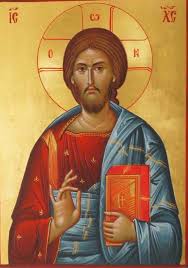
Jesus Christ, Pantocrator