fredag 24. februar 2017

The House - Moving in Slowly


We are in the process of moving. We are in the process of making the house our home.  I have tried my hand at wall papering this week. There is a bedroom upstairs we now call ‘the library’ – and it is going to house quite a number of the books. Since we plan to fill it up with bookshelves, I wondered if I really should bother with the walls behind them, but then we got some shelves without the traditional backing, and they inspired me to change the walls. I’ll put up some photos (on demand!), and if you wish, you may be part of the process…


A house is only fulfilling its intention if it is a home to someone or something. I already feel like this house is a place where I have the freedom to be me. It has friendly measures when I try to remodel; smooth ride, so far.

Before...
The room had original wall paper from 1946, and it was well worn, with numerous nail in the walls, and the corners were wrinkled. A bit of prepping was needed, but I opted to no remove all the old wall paper. I tested it out on liquid and saw it would stick.


I have not done much wall papering in my life, so I had to google a bit to get some good pointers. I like the website Vi i Villa. I learnt about corners and the rub down of the old wall paper with sanding blocks. It was a very dusty job, so the old vacuum cleaner that came with the house was very useful.


First wall done:)  Brilliant colors and patterns, don't you think?? Is this really my choice? It is. I am no minimalist and I do not care for interior with all white and light grey - but the walls - behind the shelves, they may do well with the serene look.
I found the wall paper at Claes Ohlsson in Kongsberg. Perhaps the price was inviting - ! - typical me.

Here in Norway it was not easy to find pre-pasted wallpaper, like the ones we had in the States. Here we use glue, and I smear glue on the wall.How much? I don't know. Enough, for sure.


 Here is a peak at the living room.
Moving is a messy affair, even if it is for short distances!

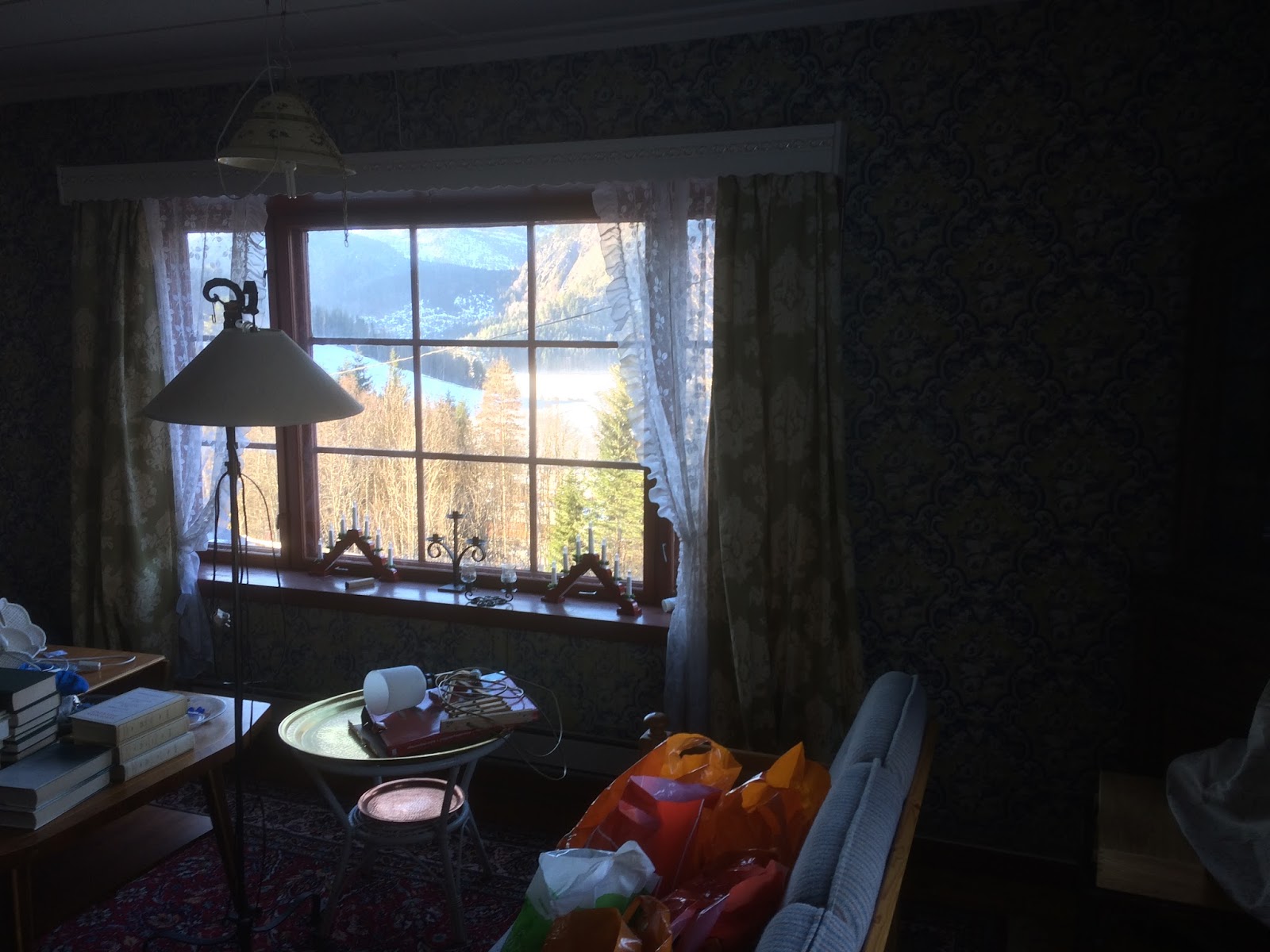
View from the living room
            

 It is starting to take shape . Two opposing walls will have the stripes and two will be in single colour, light grey.    
I measure the lengths on the floor, and I have a nice, sharp X-acto cutter, a metal square (vinkeljern) and a cutting board. The walls are 2.5 m (8.2ft)  tall, and the length f wall paper kept rolling back up, and I was struggling with them. then I hunted around in the well stocked living room for something that could function as weights on the bottom - and that helped my frustration.


The Wall. Dad likes it! Then it is good. It is nice when he complements my efforts in such a genuine way.
I just had to  put in a picture from the kitchen;) Unique. It stays.


I

lørdag 11. februar 2017

Feeling Green

Today I am going to pat myself on the back for the things I do right. Of, course, immediately I remind myself that bragging about oneself is not good. Drat. Why do I always have to be so self-righteous? I am feeling green today, but it was not caused by any conscious political agenda.

I have stopped eating red meat, apart from on special occasions. It has been claimed that beef production causes relatively much greenhouse gases. My husband and I eat a lot more vegetables, particularly roots. Breakfast consists of simple, old-fashioned oatmeal cereal and an apple. Yes, we have changed our diet, but we have not made it complicated or rigid.

I walk to work. Anything else would be silly. It takes less than five minutes. Presently we are in the process of moving to another house, and then my walk would be about 15 minutes. I look forward to a reasonable walk. (Frisking around in sleek looking hyper-expensive training gear on my free time does not fit into my life style.)

We have one car. It is a medium sized car, an older model, but it is very fuel-efficient. It is a 2005 Toyota, which runs on petrol. In Norway the lowest octane available is 95. I think it burns cleaner. We need a car here in the village, but we do not need it every day.

I just mended my husband’s favourite wool shirt, itself a throw-off from family. (It is partly moth eaten and both sleeves were ripped – but he loves it.)
I get most things second hand, by the way – it is more fun that way: Great stuff, good prices. Less waste on the garbage heaps – at least for some time. Sometimes I pick up give-aways. There are several used-stuff networks, Finn.no, local groups, or Missions’ Stores – where all they have is donated and they resell it as a fundraiser for missions. Great idea! Money given to missions is never wasted.

I do not have a dryer these days. I air-dry the clothes. It helps them last longer, I think.

If I need to find gifts, I like to buy things locally. If I look long enough, I normally find something. The village is small, but the stores have good selections. Who cares if it may be a wee bit cheeper in the big warehouse outlet in the city. I like my local stores to stick around. So, I need to support them with my shopping sometimes.

We regulate the heating with wood burning stoves. I wondered about the eco-friendliness of that – and found out that wood rots in the forest, a natural decomposing process, and it is the same fumes and gases produced there as when burning the wood, and in addition, it goes faster. I wondered about deforestation issues, but learnt that cutting down trees for fuel is necessary for the management of certain types of trees.

We sort our garbage in three categories: Paper, plastic&metals&glass, and biodegradable food waste. My husband is pretty strict about this.

There are most likely areas we can improve on. Anyone who reads this will most likely wonder: but what about…? There is room for improvement, I am sure. For it to work for me, though, it should not be too drastic and not dreary. I like the simple life. I am naturally local.


lørdag 4. februar 2017

Det sakrale rom


Tidlig i kirkens historie ble det viktig å gi uttrykk for Gudsforholdet i den arkitektoniske utformingen av rommet. De første kristne samlet seg i Tempelet i Jerusalem, et storslagent bygg med det formål å legg til rette for oppgjør med synd, for soning og renselse.  Opprinnelig var det en telt-konstruksjon som var rammen for møtet med Den Hellige, og folket var på vandring. Senere ble det et permanent tempelbygg, og instruksjoner for bygget er angitt i Mosebøkene.  Ingenting ble overlatt til tilfeldigheter eller til menneskelig forstand eller tolkning. Det er klart foreskrevet både hvordan en skulle lage de ulike kar og redskaper, for interiør og utsmykning. Offer-ritualene er intrikate, men har noe felles trekk. Presten måtte selv være sonet for, være ren før han kunne komme med sonoffer for andre. Å komme nær det hellige med urenhet av noe slag var livsfarlig. Det eneste som gjorde disse ofringene virksomme i forholdet mellom Gud og mennesker var at de ble utført på Guds løfter. Fordi Gud selv hadde lagt premissene, kunne en prest med frimodighet forvente at syndene ble sonet og tilgitt.

Det sakrale rom i kristen tradisjon har en lang historie. Som i de aller fleste bygg, er det funksjonen som definerer utformingen, men vi ser også et samspill – at utformingen gjenspeiler Gudsforholdet. De fleste lutherske kirkene i Norge har minimalt med utsmykning, men de fleste har midtgang og blikkfanget er alteret. Det er tydelig angitt retning for bevegelse. Ofte står talestol og lekter på siden av alteret, noen ganger er talerstolen hevet. Dette bygget har en særlig funksjon: å formidle Guds nåde og Guds tilgivelse for synd. Det skal hjelpe en som kommer dit til å erkjenne sin egen synd, bekjenne det for Gud, komme til Gud i bønn, og få ta imot tilgivelse, og bli styrket i troen og håpet.
            Vi har et alter, gjerne med altertavle, men vi har ikke noe offer å bringe. Når vi kommer opp, ser vi symboler i altertavlen eller i annet synlig interiør, noe som peker på Jesus som Guds offerlam.  Vi kan våge oss nær Den Hellige fordi vi har soningen i Jesus Kristus. Enhver som er født av Gud har hans Ånd. Og denne Ånden viser oss hvem Jesus er. Vi blir renset i Kristi blod – det høres litt makabert ut, men livet er i blodet, og vi må bli renset for vi kan komme inn for Guds ansikt.

Naturligvis, siden Gud ikke rommes i noe byggverk av menneskehender, kan dette møtet skje hvor-som-helst. Det er ikke like naturlig på butikken eller hjemme i stua.  Løftene gjelder et fellesskap av troende, og fra tid til annen har folk møttes under åpen himmel. Likevel, bevisst arkitektonisk utforming av det sakrale rom legger til rette for et relasjonelt gudsliv.

Jeg vet det høres forferdelig ut, men det er forferdelig. I hele Norges land kan prester og andre få skjende disse sakrale rommene og misbruke Guds navn, hans Ord og vrake løfter om forsoning og oppreisning. Eller kan de det? Så vidt meg bekjent tilhører ingen kirkebygg Den norske folke-kirke. De tilhører kommunene de ligger i. Tradisjonelt er det et menighetsråd som pusler med en del av aktiviteten i kirken, i samarbeid med Dnk, som bidrar med prest og andre betalte funksjoner. Det er fordi tradisjonelt var det statskirkeordning. Det er ingen grunn til at de lokale kirkene ikke skal kunne benyttes av kristne som er utenfor Dnk. Om argumentet mot dette skulle være at kirkene ble reist som lutherske kirker, er det bar å minne om at Dnk at ikke lenger er luthersk.  Det burde heller ikke være noen grunn til at lokale kristne ikke skal få lov til å hegne omkring sitt lokale kirkerom og verne det fra å skjendes. Jeg vil gjerne verne om det sakrale rom i bygda her jeg bor, for det er vitalt viktig for meg.


mandag 30. januar 2017

A Sense of Belonging


the lodge
I am thinking about architecture, but more than one house. I am thinking about community and about a sense of belonging. When you have been on a long journey, it feels so comforting to come home. You notice the stairs, the walkway, and the landscape. You walk with anticipation towards the front door and it is like the hallway greets you like an old friend. Before long, the kitchen and the living room are alive again.

trees!
I was on a very long journey. I liked the new and exiting experiences. I liked trying to settle in new environments. For the most part, I think I succeeded. I was on this journey for 20 years, until the doors opened to venture back. This time it was my husband who uprooted and became the stranger. For him it was like another adventure. We settled in a village where none of us had lived before. Still, I was very familiar with the wild and wonderful landscape. I had spent much time in the summers (and some tearful winter vacations) in this region. The trees were familiar. The forest, wild berries and flora, it was like it beckoned me to come and be part of them again. Ok, so I am a rational being, not much given to irrational emotions. Still, when I knew no one saw me, I gave some sturdy old tree trunks a hug!  My skin felt soft and young against the rough bark. I was happy.


the lady of the house
The people in the village had familiar features. They looked like me. I knew I might be remotely related to perhaps one third or more of the population. After all, my dad and my maternal grandmother were from these parts. I recognized short, stout noses, bushy eyebrows, long upper lips, or bright blue eyes. I saw the round faces with high cheekbones. Although I never lived here, and I did not really know too many of these people, I felt a sense of belonging.

We came here because of a job. I teach English at a Christian boarding school, a college prep school, and the students are from elsewhere in the country. Our housing is provided by the school. For more than six years we have lived in a hamlet of likeminded people, all connected to the school. I felt at home with them. I understood them immediately, and I did not have to explain myself, nor did I have to spell my name, for it was quite ordinary to them.

We do not need to be in the exact place where we grew up to find this sense of belonging, but it is good not to be too far from one’s own roots.

us
In our world it is common to move from place to place, to seek opportunities of various kinds. We seek what is good for our children, for our living conditions, for our yearning to develop in our professions, and such things. In the middle of it we need to recreate the sense of home, the sense of belonging, and it is hard. In some cases it does not materialize. In some cases, perhaps too many, we live slightly artificial lives, hurrying from one activity to another to try to make up for missing the settling feeling of being home.

What if we could map out and create small communities, small enough to be personal and large enough to give space to each other… What if we could create such a sense of belonging, which would reflect our home culture? I see a community building complex, and in it there is room for children to play safely, for older people to interact as they please, young families to connect to the older generations. I see young, single men and women not alone, not lonely, but part of a vibrant community. I see reading houses, small stores, and gardens or grow boxes. I see my own trees, woods with all the distinct plants.  

I do not know if this sort could materialize in my generation. Still, if I had an option to make something like this happen, I would much more do so than sit alone in a large villa, where I live in only segments of the house and become lonely. As long as both my husband and I live, we have each other’s company, and our children may opt to live elsewhere. So, for us, a closer sense of community may involve other people than family, in the same region. It is like the model of an extended family with common bonds and similar culture. In such a setting we help each other and we encourage each other.
Kviteseid


Perhaps is the village an extended manifestation of this idea, but still in a village will we sit in isolation and long for closer connections. The built environment encourages such isolation, and it is this aspect I would love to challenge.  Perhaps if our doors were more open, and we were more in the habit of coming in to one another uninvited, it might work. I remember those days, actually – and in my childhood I set out to simply go to a classmate and ring the doorbell. “Hi! Do you want to play?” I never thought about being accepted; it was a given. This was home, and there was a sense of belonging.

onsdag 25. januar 2017

Vegskille


Jeg hadde spørsmål i dag tidlig, spørsmål til Gud, om hvordan jeg skal forholde meg til mennesker rundt meg som ikke lenger bekjenner Jesus Kristus som Herre, til mennesker som med viten og vilje legger opp til et nytt budskap for kirken. Jeg har  ønsket å ha en viss dialog, ønsket å kunne bidra med noe, ønsket og bedt om at de individer jeg har kontakt med, vil la seg overbevise av Den Hellige Ånd om hva som er sant og rett. Jeg har ikke ønsket å se et brudd, rent menneskelig sett. Jeg har ikke villet stenge folk ute fra min sosiale setting. Lenge syntes jeg det var ukristelig å gjøre, for jeg hadde et håp om at de ville vende om.

Jeg leste i Johannes’ 2.brev, og der stå det ” Den som ikke holder seg til Kristi lære, men går ut over den, har ikke samfunn med Gud. Den som holder seg til læren, han har samfunn med Faderen og Sønnen. Om noen kommer til dere og ikke fører denne lære, så ta ikke imot ham i deres hjem, og hils ham ikke vel møtt.  For den som hilser ham, blir medskyldig i det onde han gjør.” ( 2.Joh 2,9-11)


Dette var klar tale. Johannes skriver i forbindelse med vranglære som menigheten sto overfor, en vranglære som ikke fastholder Jesus som menneske kommet i kjøtt og blod. Vi står overfor en annen vranglære: en som fornekter Jesu suverene herredømme, som fastholder mennesker i sine synder, som dreper håpet vi har for liv og fornyelse gjennom oppgjør, tilgivelse og renselse. Og hvordan skal jeg forholde meg til mennesker i mine kretser som fremmer dette? Vi har nådd en grense. Våre veier må skilles.